Buying Tips
Buying Tips Sizing: Why Size Returns Outnumber Quality Returns for Multi-Door Chains
A trading company in Dubai buffered 30 days into its plan and still ran late because the factory counted production days and not the plating and QC qu

A trading company in Dubai buffered 30 days into its plan and still ran late because the factory counted production days and not the plating and QC queue after them. The order was not lost on price. It was lost on a specification nobody wrote down. This piece looks at buying tips from the buyer's side of the table: what the promise means at the bench, what it costs to get it wrong, and how to write a brief a factory can be held to.
Where the Real Lead Time Goes, and Why You Are Usually Told the Wrong Number
Production time is not the same as order-to-ship time. Casting, setting, polishing and plating are four separate queues, and a piece can sit in the plating rack for longer than it spent at the bench.
We quote from the day the stone parcel is approved, because that is the last decision that can move a date. Everything before it is a deposit and a drawing, both of which are fast.
What the Industry Standard Delivers, and Where It Breaks
The default offer in this category is a stock photo, a unit price and a thirty-day promise. That works for one order and stops working on the second, because a stock photo cannot specify studs.
| Comparison | Common practice | What we hold | Why it matters |
|---|---|---|---|
| Stage | Days | What can move it | |
| Sample and CAD | 3-5 | drawing approval rounds | |
| Stone matching | 2-4 | hue acceptance | |
| Casting to setting | 6-8 | tree utilisation | |
| Polish and plate | 3-4 | plating rack queue |
How We Quote a Date We Can Actually Hold
Pair weight match within 0.02g is the number we publish per lot. It is the one a buyer can check with a caliper and a loupe in ten minutes, and the one that decides whether a reorder is a formality or a negotiation.
- Lot and rack reference on every carton
- Studs declared on the invoice, not assumed
- One plated sample approved per rack before the run
- Stone parcel photographed and hue band stated in writing
How Pair Is Measured
We measure pair weight match within 0.02g on every lot and record the number against the rack. It is the one figure a buyer can independently verify with a caliper, a loupe and ten minutes at the receiving table.
If the number is inside the band, the lot ships. If it is outside, it goes back to the bench rather than into a carton with a note that says the buyer should expect variation.
What One Returned Pair of earrings Actually Costs
A returned pair of earrings costs the unit price twice: once in goods, once in handling, plus the freight both ways and the customer's lost confidence. On a pair of earrings the handling is usually larger than the margin.
That is the arithmetic behind every decision on this page. A cent saved on plating is not a saving if it produces a return rate two points higher.
Sampling Plan and the AQL We Work To
We inspect at AQL 2.5 on the final line and 3 to 5 per cent on setting, sampled per carton rather than per lot. Per-carton sampling is stricter because a defect that clusters in one carton is a process problem, not a random one.
Anything above the AQL is held and reworked before packing. We do not sort after arrival, because sorting after arrival is a cost the buyer pays and a defect the buyer discovers in front of a customer.
What the Buyer Can Verify in Ten Minutes
At the receiving table: count per SKU against the packing list, weigh three pieces, measure the pair of earrings, check one stone at 10x for seat and tilt, and confirm the plating colour against an approved sample.
Five checks, ten minutes. They catch the defects that are visible on day one and free the buyer to argue about the ones that are not, with evidence rather than impression.
Specification, Field by Field
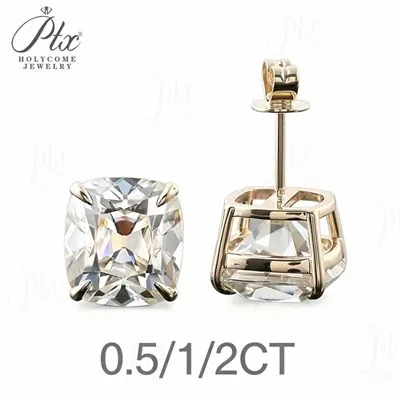
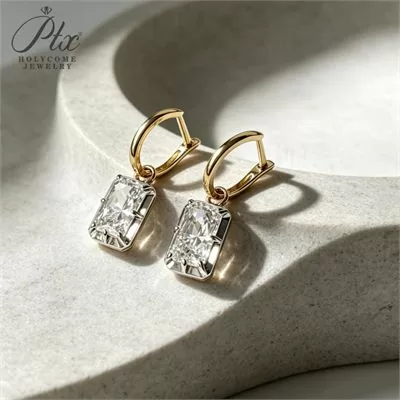
Read the specification as a checklist: studs, huggies and hoops from 3mm to 40mm with screw-back or friction posts at 0.8mm. Each comma is a decision someone made, and each decision has a cheaper alternative that a factory can substitute without telling you.
The substitution is usually invisible on delivery. It shows up as a hue shift in month three, a prong that will not hold after a resize, or a plating that reads slightly warm under store lighting.
How Pair Is Measured
We measure pair weight match within 0.02g on every lot and record the number against the rack. It is the one figure a buyer can independently verify with a caliper, a loupe and ten minutes at the receiving table.
If the number is inside the band, the lot ships. If it is outside, it goes back to the bench rather than into a carton with a note that says the buyer should expect variation.
How We Test Before the Carton Closes
Testing happens at four points and none of them is the packing table. The casting tree is checked for porosity and short fill, the setting bench for seat and tilt, the plating rack for thickness on a cross-section, and the final line for weight and dimension.
A final inspection alone catches perhaps a third of what goes wrong, because the other two thirds were decided upstream. That is why the record has four columns and not one.
Where the Margin Leaks After the Order Lands
The unit price is the visible cost. The invisible ones are returns, size exchanges, replating, markdowns and the labour of photographing a piece that arrived with the wrong tone.
On a typical wholesale programme those five add between eight and fourteen per cent to the real cost of goods. Fixing plating thickness and stone hue band removes most of it before the first season ends.
The Difference Between Capacity and Availability
Capacity is how much a line can make in a month. Availability is how much of that is free in the week you need it. Factories quote the first and deliver the second.
We quote capacity per line and then reserve a slot against your deposit, so the date you are given is a booked date rather than an average.
How We Test Before the Carton Closes
Testing happens at four points and none of them is the packing table. The casting tree is checked for porosity and short fill, the setting bench for seat and tilt, the plating rack for thickness on a cross-section, and the final line for weight and dimension.
A final inspection alone catches perhaps a third of what goes wrong, because the other two thirds were decided upstream. That is why the record has four columns and not one.
What It Costs and How Long It Takes
Fifty pieces per design is the working minimum on buying tips. A sample runs three to five days, bulk fifteen to twenty days under 500 pieces, and a custom mould twenty-five to thirty days from drawing approval. Payment is 30% deposit with the balance against the bill of lading copy.
If the order is below fifty, the setup cost per piece roughly doubles because the casting tree and the plating rack are fixed costs. That is arithmetic, not a policy to negotiate around.
| Item | Value | Note |
|---|---|---|
| MOQ | 50 pcs / design | sizes and colours can be split |
| Sample | 3-5 days | one piece, approved before the run |
| Bulk lead time | 15-20 days | under 500 pieces |
| Custom lead time | 25-30 days | from drawing approval |
| Payment | 30% / 70% | balance against B/L copy |
| Port | Guangzhou / Shenzhen | export from Wuzhou |
Frequently Asked Questions
What is the lead time for buying tips?
Sample in three to five days. Bulk in fifteen to twenty days for runs under 500 pieces. Custom work with a new mould runs twenty-five to thirty days from drawing approval.
Can you ship faster?
Yes, at a real cost. We can hold a plating rack slot and run your lot ahead of the queue, which adds roughly 12% to the unit price for a ten-day delivery. We will not promise a date we cannot hold without that surcharge.
What causes the biggest delay?
Stone acceptance. A buyer who rejects a parcel on arrival restarts the matching clock and loses a week. Approving stones from a photograph with a stated hue band is the single fastest fix.
Do you ship partial orders?
We do, but only on the same lot. Splitting a lot across two shipments doubles the freight and customs handling per piece and usually costs more than waiting.
Can you produce a second lot identical to the first?
Yes, if we hold the four inputs: alloy batch, stone parcel, plating tank and setting team. The reorder sheet records all four, so the check happens against a document rather than against a memory.
What happens if the lot arrives outside the agreed tolerance?
Photograph the piece with a scale and reference the lot line. Above the agreed AQL we replace and cover freight; inside it we replace the affected units inside ten days.
About the Manufacturer
HOLYCOME by Wuzhou HengliLai Jewelry Co., Ltd. runs casting, setting, polishing and plating on one site in Wuzhou, Guangxi, the artificial gemstone cluster that supplies most of the trade. Monthly capacity is roughly 60,000 pieces across silver and gold lines. Buyers can reach the trade desk at service@holycome.com or on WhatsApp at +86 18078079070, and a factory visit can be arranged with two weeks' notice.
Next Step
If you are pricing buying tips for a season, send the quantity per design, the stone grade you need and the date you need it on the shelf. We will return a drawing, a landed cost and a production date within three days, and a physical sample before you commit to a run. Samples are charged at cost and credited against the first order.
Related reading: Silver Soldering Fire Scale: Prevention and Removal, Bench Polishing Final Stages: The Last 10% That Sells, Jewelry Casting Spruing: Runner Design That Saves Castings